
Miranda Priestly was never the problem

I’ve watched The Devil Wears Prada many times and never tire of it. It’s a movie with many winning aspects: a great cast, clothes, interesting characters, some drama, a narcissistic boss in a stressful industry, and a solid plot. I was more into the BlackBerry back then than the narcissistic leaders I focus on now, but thankfully, this movie satisfies both interests. It came out in 2006 and still presents a predictable and toxic workplace culture that was more acceptable, and even seen as necessary for success, than it is today, 20 years on.
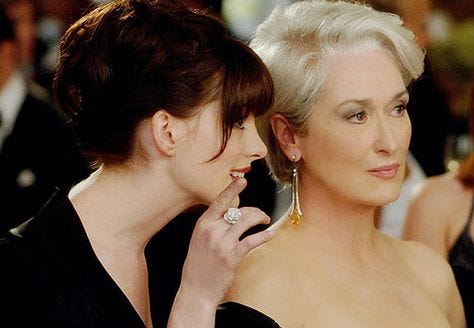
The Devil Wears Prada centres on our protagonist, Andy (Andrea), the somewhat naïve striver who wants to break into the journalism world with a start as an assistant to the Editor-in-Chief of Runway Magazine (a fictional Vogue), Miranda Priestly. Miranda is your textbook calculating, ruthless, narcissistic leader that everyone reveres, fears, and despises at once. She is Runway magazine. As her loyal creative director Nigel says, “Her opinion is the only one that matters.” This makes her incredibly powerful and very protected, as she positioned herself as a guardian of Runway’s reputation and a producer of legitimacy and acceptability.
Runway is a successful magazine because it defines fashion and inspires reverence with Miranda at the helm. This means she needs the right people around her to sustain that position: visionaries, enablers, and high-performing compliant operators who embody its image and understand what’s required to maintain the institution, not just perform the work.
Andy enters this environment with a reasonable yet naïve set of assumptions. She knows nothing about Runway or fashion and doesn’t yet understand what the role demands. She treats the job as a temporary foothold into journalism, assuming that doing it competently will be enough to move on. This is an attitude common among early career professionals entering institutional environments for the first time.
Inside Runway, Andy’s assumptions are demolished in real time. Emily enforces Miranda’s expectations to the extreme, like a good cult devotee and expects Andy to keep up or get out of her way, because Andy’s mistakes reflect on her. Nigel is the loyal Golden Child, offering the right balance of snark and advice for Andy to function while remaining fully aligned with what Miranda and the magazine require.
Andy’s naivety is short lived as she chooses to assimilate into the culture. It occurs through small adjustments that make sense to her at the time. She begins to see what matters to Miranda and acts accordingly, anticipating what Miranda needs before it is asked. Her change is rewarded by Miranda’s approving glances that serve as breadcrumbs as she’s given more responsibility and more loyalty tests to maintain approval.
Andy steps into opportunities that Emily has been working toward and takes them without hesitation. She knows what they represent and she takes them anyway.
No one pulls her aside at work. She brushes off her friends’ and boyfriend’s disapproval as a lack of understanding of her pressures. There’s no moral reckoning as she stares in the bathroom mirror. She’s worked hard and sacrificed her relationships to get to where she is, and she’s not stopping now. “I had no choice” is the perfect narrative to assuage her guilt.
It’s easy to fixate on Miranda as the cause of the stress and cutthroat behaviour. She’s a rare woman at the helm of a high-profile and iconic business, and there are enemies waiting in the wings to replace her with a younger, cheaper model. She’s the one who holds all the power and is excellent at abusing it to get what she wants. She’s ruthless, demanding, manipulative, narcissistic and is exactly what the institution needs her to be to remain relevant and successful, while keeping herself out of early retirement.
So is it Miranda or is it the type of system she’s in that pays her to do what it needs for longevity in a cutthroat industry?
This question is relevant if we assume individuals operate independently of the conditions that reward them. If you’ve read my work, you’ll know that I don’t believe they do.
Miranda is a product of Runway, not the other way around. She didn’t arrive fully formed and impose herself on the institution. She became what the institution could use and keep.
Every institution begins with a creative spark to fill a gap in a market or to solve a real problem, and ends by protecting itself from the consequences of having done that well.
What happens at Runway follows a pattern that emerges in any institution that succeeds long enough.
Behold the institution life cycle!
The life cycle of institutions
1. Early stage
People deal with things as they arise, often in the middle of something else, without the need for a meeting to discuss it. A layout is opened up on a desk and anyone who glances over offers immediate reactions and thinks out loud rather than after reflection. Someone points out a problem and the person responsible responds in that moment, adjusting, defending, or abandoning it while everyone watches in real time. Decisions happen on the spot and the work changes before the conversation is over.
Producing the work and talking about it happen at the same time. The right people are whoever is there. No one waits to be included or worries how their comment is received. There isn’t pressure to be compliant or agree with anyone. Everything is out in the open, including mistakes and missteps, and they’re corrected without fanfare or needing a ‘difficult conversation.’
Some people start getting it right more often, and everyone notices. An editor calls a change that improves the page and it sticks, then does it again the next day and is right again. No one pretends all opinions carry equal weight, though they’re not managing that difference yet. They still argue, just with a growing sense of which calls tend to hold.
When something works, it stays because it works. It doesn’t need to be pre-approved or routed through anyone else to survive.
2. Growth stage
As more people start to rely on the work, fewer things can be resolved in the moment. Discussions no longer remain contained because a bad decision has wider impact, costs more, and takes longer to fix than before1. People feel a stressful pressure rather than the exciting startup pressure, even if no one says so.
Ideas are no longer presented raw and unfiltered, and have to go through a soundboard process with someone else beforehand to refine them enough to share. No one argues things out in the open anymore because they’re discreetly handled before a meeting or never raised at all.
People still speak, though not in the same way. A point that would have been pushed all the way through is raised once and then left alone if there isn’t enthusiastic uptake. Someone notices which reactions slow things down or create tension and avoids triggering them the next time. Their contributions are tempered by self-restraint and discernment to avoid getting under the boss’s skin.
Conversations take a bit longer to reach the same outcomes. Ideas that need more back and forth begin to feel heavier than they’re worth, and some get dropped earlier.
Deadlines start to matter in a way they didn’t before. Fewer things are reworked on the spot. The space that once allowed for messy fixes in real time starts to close.
Nothing dramatic has happened. People are still doing their jobs and the work still gets done, just within a narrower set of conditions than before.
3. Preservation stage
More people depend on the work being predictable, so fewer decisions are left loose. People settle things earlier and bring forward something that already fits what is known to be acceptable.
Someone checks with their manager before sharing something more widely. Another waits for sign-off because it hasn’t gone through the right line yet. People start copying others in so nothing moves without the right visibility.
There are more managers, and they expect to be kept informed. Updates become part of the work. Meetings are booked with specific people. Notes get taken and circulated. Forms get filled out and processes get followed. HR sits alongside the work, setting expectations about behaviour and how issues are handled2.
People still contribute, though they do it with more awareness of how it will be received. A point is raised once and then left alone if it creates tension. The same person brings a version of it later that is easier to accept. The work still gets done, it just happens through clearer lines, more checks, and more people involved in keeping it that way.
4. Late stage
Everything still looks perfect. Every output comes together exactly the way it’s supposed to: polished, controlled, impossible to fault at first glance. Nothing is messy or unfinished, and that’s the point because nothing is actually new. The ideas are familiar, just updated enough to pass as fresh, like something you’re sure you’ve seen before but can’t quite place, drawn from what has already worked elsewhere and reshaped to fit what now passes.
Meetings are now about making sure nothing causes a problem rather than pushing anything forward. Work gets approved because it’s safe, it won’t upset a partner, a stakeholder, or anyone important enough to have a say over revenue or reputation. A piece that might have started out sharp or interesting gets softened along the way, shaped against an unspoken list of what you’re no longer allowed to say, until it fits neatly into place. Everyone can tell when something might go too far, and it disappears before anyone has to say no out loud, as if it was never there.
The leader is still the leader, their name still carries weight and keeps the system intact. Anything that reaches them has already been filtered, shaped, and narrowed down to what will hold up publicly and commercially3. They remain the centre of everything because the brand depends on it, even as the terms are set around them and their influence no longer extends the way it once did.
People say the right things, reference the right people, and stick to what has worked before. No one wants to be the one who pushes too hard or introduces something that doesn’t please the leader and puts them under scrutiny.
The workplace still signals quality and authority and looks like it’s the leader, when it’s not. It follows what’s already working somewhere else, shaped by those with more influence, refines it, and presents it as its own4. It is holding its place by a thread while everything that once made it matter keeps happening somewhere else, and you wouldn’t know it because of the constant PR machine keeping it that way.
Runway would be described by many workplace culture critics as a toxic workplace, and I would have agreed each time I watched it until recently. It’s how a mature institution in decline operates within the established conditions required to sustain its position of relevance and status.
A workplace that looks like it’s dysfunctional begins to make sense when viewed as part of a broader pattern. The behaviour of its employees follows a progression that has been described in parts across different fields. This piece synthesises concepts from organisational sociology, political theory, and bureaucracy research into a behavioural model of institutional decline that I haven't encountered elsewhere.
My prediction for The Devil Wears Prada sequel
Andy walks back in twenty years older and still eager, like someone returning to something that once mattered, intending to get it right this time. She carries experience and expects that to be acknowledged. Miranda does her usual ‘who are you,’ treating Andy as an insignificant blip, re-establishing the dynamic immediately. This is a typical grandiose narcissistic leader move to entice Andy to prove herself, while putting her in a constant state of cognitive dissonance by withholding approval and dropping loyalty tests dressed as opportunities, each one calibrated to see how far Andy will go now that she has more to lose and more to prove. Andy is quickly back in her awkward twenties playing this game, like she’s earning her place instead of taking it. That is, until an opportunity arises that allows her to deliver exactly what’s needed, producing her rise in status with Miranda’s approval.
Andy delivers something that seems to work that stabilises the immediate pressure. She secures what Runway needs in the short term and allows Miranda to maintain continuity without conceding control. That outcome is claimed by the institution and treated as evidence of its ongoing strength.
The approval is immediate and fleeting, and the next demand follows before she has time to use the loo.
Andy now recognises the pattern. She’s seen it before, just without the access, the stakes, or the illusion that it might lead somewhere different. She knows what’s required to stay where she is and what it would take to move beyond it.
She keeps going anyway.
Miranda glances up, already onto the next thing.
“That’s all.”
This shift from doing the work to managing the consequences of the work reflects goal displacement, where processes begin to take precedence over purpose.
Merton, R. K. (1940). Bureaucratic Structure and Personality.
The emergence of formal processes, documentation, and role-based authority reflects the bureaucratisation of work described by Weber.
Weber, M. (1978). Economy and Society (G. Roth & C. Wittich, Eds.). University of California Press. (Original work published 1922)
The concentration of decision-making at the top reflects Robert Michels’ iron law of oligarchy, in which organisational complexity drives the consolidation of power within leadership groups over time.
Michels, R. (1911). Political Parties.
This reflects Pournelle’s iron law of bureaucracy, where those focused on preserving the organisation come to dominate its direction, often at the expense of its original purpose.
Pournelle, J. (1989). “The Iron Law of Bureaucracy.”
For the sequel, are there possible "multiverses" where Andy either defeats or overcomes Miranda and while staying her own person, or a darker one where Andy defeats Miranda and becomes the same narcissist that Miranda was?
In any case, reminds me of Heathers for grown-ups.
The four stages remind me of Robert Heller's saying that "the first myth of management is that it exists", just manifesting itself in different ways depending on the stage.