
Suicidal Empathy Is Toxic Compassion
My two cents on concept creep

The belief that empathy and compassion are interchangeable has led many to blame empathy for problems created by toxic compassion.
I know this declaration will get me in trouble with people who are already certain that empathy is the problem, but hear me out.
I was inspired to write this article after coming across two excellent articles on suicidal empathy by Lucy and Harrison Koehli. I had recently introduced toxic compassion as a form of female covert aggression and explored how it operates. While writing this article, a positive review of Gad Saad’s new book Suicidal Empathy (which I haven’t read) appeared in my LinkedIn feed. The review described Saad’s central argument as the belief that empathy in politics leads to civilisational collapse, then referred to the problem as misguided compassion. The language shift captures the confusion at the centre of the book’s premise whereby empathy receives the blame for actions the reviewer describes as compassion.
My own interest in empathy began in 2010 at the end of my life as a research scientist upon shadowing paediatric oncologists in their clinics with adolescent and young adult cancer survivors. I noticed oncologists’ moral dilemma of using the best of the technology and medicine they could access to treat a child’s cancer and see the detrimental secondary effects later in their short lives after hearing one say “now let’s see the damage we did because of their treatment.” This intrigued me enough to go down a rabbit hole to investigate the impact on doctors wellbeing and why no one was talking about it. I also noticed that some doctors seem to lack empathy, or at least appear stoic and transactional even among their peers which struck me as odd alongside the overtly caring doctors who kept their phone on 24/7 so their patients could reach them. Those observations began a long investigation into the nature of empathy, the conditions that preserve it, and the barriers that prevent people from demonstrating it well. That work eventually led me to question two widely accepted concepts: compassion fatigue (an article for another time) and, more recently, suicidal empathy.
Along the way I also developed eye roll fatigue with empathy variants that proliferate in the literature before being proselytised as leadership values across LinkedIn. Cognitive empathy, affective empathy, compassionate empathy, emotional contagion, dark empathy and, more recently, suicidal empathy reflect attempts to describe different aspects of human experience and behaviour. Some are useful distinctions while others collapse entirely different human processes into empathy, making it difficult to know what anyone means when they use the word.
My understanding of empathy comes from the Working in Partnership Model1 (also known as the Family Partnership Model), a relational approach informed by the work of Gerard Egan, Carl Rogers, George Kelly and Urie Bronfenbrenner. The model was developed to help practitioners build effective partnerships with families and other professionals to facilitate positive change for children, strengthen parenting practice and support practitioners' own professional development to overcome the judgemental expert-led practice that was driving many families away. Since 2012, this model has shaped how I understand empathy, effective communication, healthy relationships, and true leadership. It defines empathy as both a personal quality and an interpersonal skillset demonstrated through a sincere attempt to understand another person's perspective, context and experience so they’re more inclined to want to connect with you. The quality is expressed through interpersonal skills that communicate this genuine attempt to understand, strengthening trust, connection and the other person's willingness to share more of their experience.
Empathy isn’t:
“I understand you.”
It’s:
“I’m demonstrating my sincere attempt to understand your perspective, context and experience, and my appreciation for how you’re living with it using a range of interpersonal skills like curiosity, reflective listening, suspending judgement, summarising, testing assumptions. I communicate that attempt through empathic behaviours that invite you to expand, clarify or correct my understanding. As you hear yourself describe your experience and hear my reflections of it, you also begin to refine your own understanding of what you’re thinking, feeling and experiencing. I’m like a mirror that helps you discover patterns, contradictions, meanings and priorities that were outside your awareness and that you hadn’t previously articulated. The quality of the interaction strengthens trust and connection even when we disagree because the focus remains on trying to understand you rather than judge you.”
Empathy can also involve feeling what another person is feeling. That feeling gives us another source of information to work with and can guide what we ask or reflect back. The feeling doesn’t come with a certificate of accuracy. Until we check it with the person, it remains our interpretation, filtered through our own experience and distortion.
How do you know someone is empathising with you?
Look at what they actually do. You would see them:
ask open-ended questions (not leading questions)
listen
reflect
summarise
check assumptions
invite correction
suspend judgement
continually refine their understanding
The evidence is that you would feel comfortable to continue to elaborate, correct, reflect and deepen the conversation because the interaction seems like an authentic attempt to understand you. You would also have a deeper understanding and perhaps insight about your experience that emerged from their reflective approach that you didn’t have before the conversation.
Most contemporary writing about empathy tries to pin down what it actually is by breaking it into affective empathy, cognitive empathy, compassionate empathy, emotional contagion, perspective taking and dark empathy. These labels try to separate what someone feels, how accurately they understand another person, and what they do with that understanding. Our feelings are constructs — assumptions, projections, and interpretations about the other person or group. Feeling their pain doesn’t mean you understand their experience or know anything else about them. The problem is that the effort to define empathy more precisely has stretched it to include processes that aren’t empathy.
One term I find useful is ecpathy2, introduced by psychiatrist Dr. José Luis González de Rivera to describe a mental skill that protects us from emotional overwhelm and emotional capture. It allows us to maintain emotional boundaries while remaining attuned to the other person and shouldn’t be confused with apathy or detachment. Ecpathy stops us from treating every feeling that enters our body as reliable intelligence because we can feel something intensely and still be spectacularly wrong about what’s happening for them.
Dark Empathy is just fake empathy
Dark empathy is not a thing. The term describes someone reproducing the appearance of empathy to gain another person’s confidence and use what they reveal against them.
Questions, reflection, summaries and personal disclosure can all be used to demonstrate empathy, although their use alone doesn’t tell us whether someone is empathising. We need to examine what the person is doing with each interpersonal skill and whether the interaction helps the other person develop and deepen their own understanding.
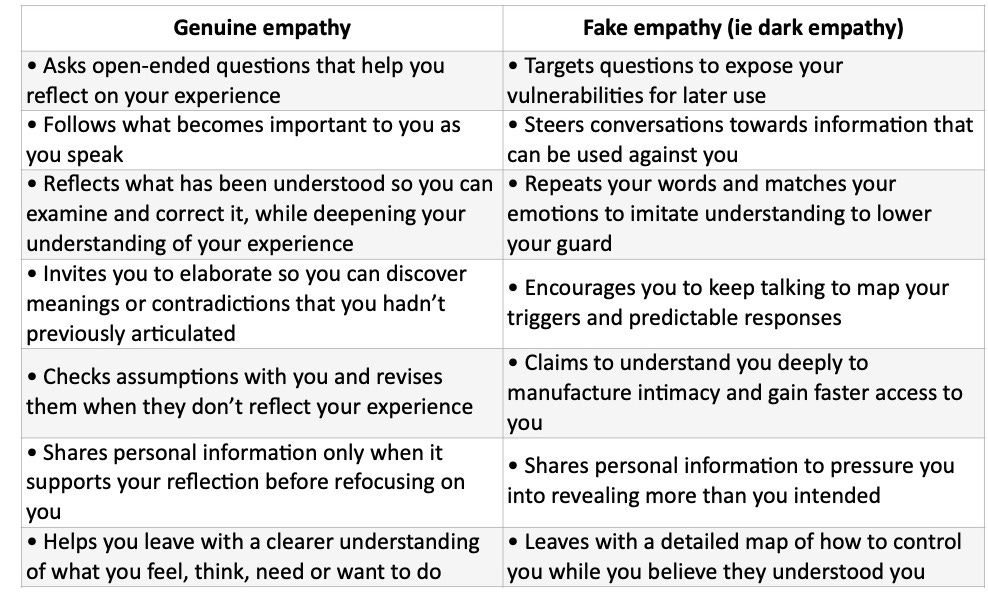
Calling this dark empathy rebrands manipulation as distorted empathy. The person engineers the experience of being understood by reproducing behaviours associated with empathy then uses the information they gather to influence and control.
The label cognitive empathy can create a similar problem when it treats working out what someone thinks or feels as equivalent to empathising with them. A person can study someone’s behaviour, identify what provokes a predictable response, then use that knowledge to manipulate them without helping them reflect on their own experience.
A hostage negotiator also enters a conversation with a tactical goal, although the interaction still helps the hostage taker reflect. The negotiator asks questions that help the person articulate what they want and hear their own thinking more clearly. As the conversation progresses, the hostage taker begins to see possibilities they couldn’t see at the beginning and develops a clearer understanding of their own position. The negotiator’s external purpose doesn’t turn the conversation into information extraction because the process continues to centre the other person’s reflection.
Empathy keeps the focus on the person whose experience is being explored. They gain the experience of being understood while coming to understand themselves more deeply through another person’s genuine attempt to understand them. The same conceptual confusion occurs when emotional identification is described as empathy.
Empathic capacity is a function of maturity
Harrison Koehli of the Political Ponerology Substack correctly argues that empathy has been conflated with emotional identification. In his article he draws on Kazimierz Dabrowski’s developmental levels to explain increasingly sophisticated forms of syntony, identification, and empathy. I agree with the progression he describes but have a different interpretation.

At Level I, Dabrowski describes temperamental syntony, as a superficial, automatic and unreflective feeling of commonality with another person or group. You feel an affinity with another person or group without reflecting on the individual experience beneath that feeling. This feeling of commonality is governed by the mood of the moment and can disappear when a conflict of interest arises.
Koehli uses Ted Bundy’s habit of pretending to be injured to illustrate how easily a syntonic response can be exploited. Bundy wore a sling or used crutches and asked women to help him carry something to his car. The apparent injury activated an immediate impulse to assist him before the women had any reason to question the situation. Bundy was presenting himself as vulnerable because he understood that a woman’s automatic concern could be used to draw her in.
At Level II, syntony fluctuates according to external influences and identification becomes more specifically directed towards another person. The person identifies with their own image of someone without checking whether that image reflects the other person’s actual experience. This identification can become obsessive and so consuming that the person begins to lose their own identity. This resembles narcissistic projection and idealisation, where the person identifies with their own image of someone and turns against them when reality disrupts it.
Koehli places some examples of what is currently called suicidal empathy at this level because the person identifies with a projected image of someone as helpless or oppressed without checking that image against reality. He argues that other examples attributed to suicidal empathy arise from a different process he describes as something like sadistic resonance (great term!).
At Level III, identification becomes more selective as the person develops their own hierarchy of values. Dabrowski says syntony begins to transform into empathy through reflection, self-evaluation and a growing understanding of other people as unique individuals.
At Level IV, Dabrowski describes empathy as becoming more discerning through greater self-observation and self-control. He places particular emphasis on concern for people who experience injustice.
At Levels IV and V, Dabrowski links his highest expression of empathy with responsibility for others and a willingness to sacrifice one’s life for them. He extends this concern beyond people someone knows personally to all living beings.
I see this progression as increasing emotional and moral maturation that expands a person’s capacity to demonstrate empathy well. At low levels of emotional and moral maturity, projection, identification, unreflective syntony, certainty, moralising, and black-and-white thinking interfere with a genuine attempt to understand another person. These are the same behaviours I described as narcissistic in one of my foundation pieces on interpersonal narcissism.

As people mature, they develop greater capacity to tolerate ambiguity, regulate their emotional responses, exercise discernment and self-restraint, examine their assumptions, and remain curious when someone sees the world differently. These capacities allow them to sustain a genuine desire and attempt to understand another person’s experience without replacing it with their own projections.
At greater levels of maturation, empathy is demonstrated through more sophisticated use of genuine inquiry, suspension of judgement, meaning making, and the continual refinement of understanding as I described in my definition of empathy above.
Dabrowski’s higher levels also reinforce two assumptions that have made empathy difficult to define.
Empathy is primarily demonstrated when someone is suffering. Nope. Empathy can be demonstrated in relation to any human experience, including one that is joyful or completely ordinary.
Greater empathy produces a greater desire to help. Also no. No one needs to do anything as a result of empathy. Empathy has fulfilled its purpose when the other person feels deeply understood and develops a deeper understanding of their own experience through an interaction that strengthens the connection between both people. In that sense, empathy is the help.
By including responsibility for people experiencing injustice and a willingness to sacrifice oneself for them, Dabrowski muddies the waters by bringing compassionate action into his definition of empathy. Empathy develops when feeling with another person becomes reflective and contributes to a deeper connection between both people. Responsibility and self-sacrifice concern what someone chooses to do about suffering, which is how compassion is demonstrated.

Compassion is not empathy
Compassion has become synonymous with being nice, kind, caring and validating, a narrow view overlooks the breadth of behaviours through which compassion can be demonstrated.
Compassion is the perception that a situation calls for action that preserves the humanity and dignity of everyone involved. It requires dispassionate judgement to determine the appropriate response without allowing emotion to cloud reason. Demonstrating compassion can involve setting a hard boundary, delivering an unwelcome truth or imposing consequences as a form of love in action. Those actions can feel harsh to the person receiving them without humiliating them or reducing them to someone who no longer deserves dignity. It also involves considering the wellbeing, dignity and legitimate interests of everyone affected rather than privileging one person's suffering over another's.
Toxic compassion bypasses the empathic process. It responds to someone’s perceived vulnerability or a claim that they have been harmed or might be harmed before any empathic engagement has occurred. The desire to protect someone from harm or distress justify actions that disregard the dignity or legitimate interests of others. It can reinforce destructive behaviour and demand unrealistic or unjust compromises from everyone else.
Lucy in her piece on Suicidal Empathy describes how images of suffering children can command public attention while children experiencing comparable suffering elsewhere remain largely unseen. A single identifiable child can generate a stronger response than reports describing thousands of deaths because people respond more intensely to a person they can see. Repeated images create an urgent demand to protect the visible victim, while the political actors surrounding the child, the interests served by circulating the images and the consequences of the proposed response receive far less examination.

Lucy describes this as weaponised empathy. I see the images as activating an emotional reaction that develops into toxic compassion when people demand action before attempting to understand the broader circumstances. The suffering and the emotional response to it are real. However, the distortion develops when the visible victim becomes the entire context and every question seeking facts about responsibility, competing interests, or consequences is treated as indifference to their suffering.
Toxic compassion can elevate someone into a sacred victim whose perceived vulnerability exempts them from the ordinary expectations of curiosity, accountability and reciprocity. The individual is replaced by assumptions about the group they represent and what the saviours protectors believe they feel and need.
Toxic compassion is a socially acceptable form of covert aggression used to establish control and dominance. The sacred victim provides moral cover, and the designated oppressor becomes a legitimate target for punishment. People demonstrate their goodness through whom they protect and assert dominance through what they force everyone else to accept. This is how Social Injustice Warriors use covert aggression to claim moral authority as saviours by designating the territory they will protect and attacking anyone who challenges their control over it.
Josh Slocum has described this throughout his Substack and other forums as narcissistic reversal, where the person claims the moral status of a caring protector while directing aggression towards the people expected to bear the consequences and enabling the person who continues to harm them. This captures the inversion at the heart of toxic compassion — the person claims they care while showing disregard and even contempt for the people expected to bear the consequences.
At population scale, institutions embed this covert aggression in policies and security measures built around the projected vulnerability of one group. Citizens are compelled to accept and take on the increased risk, and objections are treated as evidence of moral deficiency. Protecting the culture and keeping citizens safe become subordinate to maintaining the protector’s moral status.
When protecting the sacred victim requires other people to live with the consequences of that person’s behaviour while the protected person is spared accountability, toxic compassion becomes suicidal compassion. The person continues to protect the projected victim even when that protection compromises their own safety or the wellbeing of the people around them. Evidence that the protection is enabling destructive behaviour is either downplayed or creates demands for greater tolerance and accommodation.
From what I’ve ascertained from his many interviews and tweets is that what Gad Saad calls suicidal empathy follows this pattern. A perceived vulnerability triggers the impulse to protect before anyone has engaged empathically with the individual or considered the consequences for everyone affected.
Ironically, empathy could interrupt this process by bringing people into contact with the individual behind the projected vulnerability. It would also reveal the experiences of the people expected to take on the consequences of protecting them.
The compassion becomes suicidal when preserving someone’s status as a sacred victim requires other people to surrender their safety, dignity or legitimate interests, and any resistance is treated as evidence that they lack humanity.
Lucy applies this to images of children in Gaza and demands for Israel to agree to a ceasefire while Hamas continues to hold hostages and expose Israelis to further attacks. In her account, concern for Palestinian children becomes a demand that Israelis accept continuing danger, while concern for Israeli safety is treated as proof of indifference to Palestinian suffering. I would describe this as pressuring Israelis into suicidal compassion by requiring them to surrender their own safety to protect Palestinians.
Empathy has become a conceptual dumping ground for emotional contagion, projection, identification, manipulation and compassionate action. Once every response to another person’s feelings is called empathy, the word loses its meaning and blamed for consequences that a sincere attempt to understand might have prevented.
Empathy is an important quality and interpersonal skillset that needs a reboot because it’s used in all the wrong ways and blamed for all the wrong things.
Have I just turned empathy into my own sacred victim?
Hack Narcissism and support my work
Hacking Narcissism is for people trying to make sense of and effectively navigate a morally distorting and chaotic age. When moral development is disincentivised, people lose reliable reference points for discernment and struggle to distinguish between what’s real, what’s performative, and what’s covertly shaping their perception.
Narcissistic traits are expressed in everyone (often referred to as Cluster B traits). They flourish during periods of moral decline because they help secure status, protection, and significance in environments where norms of what appears correct, rather than what is grounded in moral principles, regulate behaviour. The effect of this behaviour is experienced in all types of relationships, including in workplaces, where people can be punished for violating norms they never agreed to and were never made explicit.
By supporting my research and writing, you’re supporting an effort to understand the processes shaping reality and relationships, to disentangle from dysfunctional relational dynamics, and to remain anchored to truths that guide perception rather than allowing external influences to shape it. Your support enables me to continue making sense of patterns that many people recognise but struggle to articulate, and to clarify the actions that allow people to free themselves from those patterns.
Here’s how you can help:
Order my books: The Little Book of Assertiveness: Speak up with confidence and The Scapegoating Playbook at Work
Support my work:
through a Substack subscription
by sharing my work with your loved ones and networks
by citing my work in your presentations and posts
by inviting me to speak, deliver training or consult for your organisation
Davis, H., & Day, C. (2010). Working in partnership: The family partnership model (2nd ed.). Pearson Education.
González de Rivera, J. L. (2004). Empatía y ecpatía. Psiquis, 25(6), 243–245. https://luisderivera.com/wp-content/uploads/2012/02/ecpatia.pdf
It really seems as if narcissistic traits are at the root of people hijacking empathy and compassion.